Laser blasts might help scientists tweak Earth’s thermostat by shattering the ice crystals found in cirrus clouds.
Zapping tiny ice particles in the lab forms new, smaller bits of ice, researchers report May 20 in Science Advances. Since clouds with more numerous, smaller ice particles reflect more light, the technique could combat global warming by causing the clouds to reflect more sunlight back into space, the scientists say.
Scientists from the University of Geneva and from Karlsruhe Institute of Technology in Germany injected water drops into a chilled chamber that mimics the frigid conditions high in the atmosphere, where wispy cirrus clouds live. The water froze into spherical ice particles, which the scientists walloped with short, intense bursts of laser light. When the laser hits an ice particle, ultrahot plasma forms at its center, producing a shock wave that breaks the particle apart and vaporizes much of the ice. The excess water vapor left in the aftermath then condenses and freezes into new, smaller ice particles. Applying this technique to clouds is “a long, long, long way in the future,” says physicist Mary Matthews of the University of Geneva, a coauthor of the study. Current laser technology is not up to the task of cloud zapping — yet. “What we are hoping for is that the advances in laser technology, which are moving faster and faster all the time, will enable high-powered, mobile lasers,” Matthews says.
But tinkering with cirrus clouds could backfire if scientists aren’t careful, says atmospheric scientist Trude Storelvmo of Yale University. The clouds also trap heat, through the greenhouse effect, so breaking up their ice particles could actually warm the Earth. The method“could potentially work, but only if you target certain types of cirrus clouds,” she says, such as those that are very thick.
There could also be warming if fossil fuels are burned to power the laser, says David Mitchell of the Desert Research Institute in Reno, Nev. “I think it’s really interesting research, but I’m just not seeing how it’s going to make the world a cooler place.”
U.S. 191 is one of the driving options for people headed to Grand Teton or Yellowstone National Parks. But the road also cuts through prime territory for mule deer and pronghorns. And cars and large wildlife don’t usually mix well. When they do tangle, the cars end up heavily damaged, and the animals end up dead.
In an effort to reduce this conflict, the Wyoming Department of Transportation spent nearly $10 million to install two overpasses and six underpasses, along with deer-proof fencing, on sections of the highway near Daniel Junction in 2012. The sites for the passes were chosen based, in part, on the migration patterns of mule deer and pronghorns through the area.
Shortly after the installation, the animals were seen using the crossings, and vehicle collisions appeared to decline. The project was labeled a success. Now, an analysis of the project finds just how successful it has been: Car collisions with pronghorn have disappeared entirely and those with mule deer have dropped by 79 percent, Hall Sawyer of Western Ecosystems Technology Inc., and colleagues report May 16 in the Wildlife Society Bulletin.
Two digital cameras were installed at each overpass and one at each underpass to monitor wildlife using the crossings during the spring and fall migration periods in 2012 through 2015. Thousands of animals started using the pathways, and each year, more and more animals crossed the highway using these safe paths. Over the years, 40,251 mule deer and 19,290 pronghorn made their way through the passages.
Of the mule deer passing through, 79 percent used the underpasses. But among pronghorns, 92 percent took the overpasses. This confirms something that researchers had thought would be true but never really had any data to back up. They figured that ungulates such as pronghorns that live in open areas and are heavily reliant on vision to detect predators should prefer overpasses, because the structures would allow the animals to have better vision and movement. The new finding supports this, at least for pronghorns, and shows that building overpasses, which are more expensive than paths beneath highways, really is necessary for some animals.
This area of U.S. 191 was one of the worst for wildlife vehicle collisions before the crossings were built, averaging 85 per year from 2005 to 2012. By the third year after the installation, though, collisions had dropped to just 16 per year.
When the crossings were put in place, the Department of Transportation claimed that, by preventing vehicle collisions, the project would essentially pay for itself in 20 years. But this project has been so successful, the team calculates, that a crossing could pay for itself in just 4 years. And then, of course, there’s the benefit for the wildlife itself, which can now more easily and safely move through the landscape. The team does note that Wyoming did have to make a few adjustments to the project to accommodate human behavior. The overpasses are edged with high berms to prevent animals from seeing the highway, but those berms proved tempting to ATV users and motorcyclists. Because this activity is damaging to vegetation and could reduce effectiveness of the crossings, the Bureau of Land Management had to post signs warning people away.
And when the crossings first went up, some canny hunters figured that the overpasses were good spots to find hundreds of pronghorn; hunting is now banned within 800 meters of a wildlife overpass.
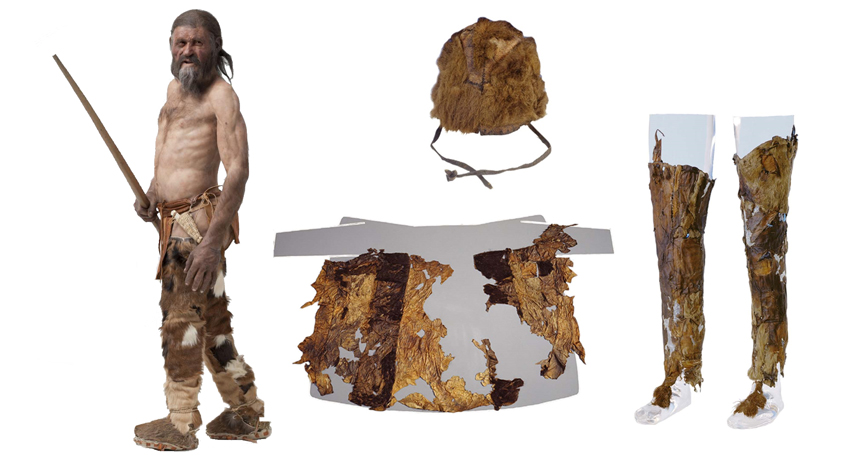
The 5,300-year-old Tyrolean Iceman, whose body was found poking out of a glacier in the Italian Alps in 1991, incorporated hides from at least five domesticated and wild animal species into his apparel, a new genetic study finds. Comparing mitochondrial DNA extracted from nine ancient leather fragments with DNA of living animals revealed the makeup of Ötzi’s clothes and a key accessory, says a team led by paleogeneticist Niall O’Sullivan. Mitochondrial DNA typically gets passed from mothers to their offspring. Little is known about what people wore during Ötzi’s time. The findings provide a glimpse into how ancient European populations exploited domesticated animals to make clothes and other items.
Ötzi’s coat consisted of hides from at least three goats and one sheep, the scientists report August 18 in Scientific Reports. This garment may have been periodically patched with leather from whatever animals were available, the team suggests.
Goats also provided skin for the Iceman’s leggings, the new analysis indicates.
A sheepskin loincloth and a shoelace derived from European cattle round out Ötzi’s attire made from domesticated animals.
As for wild animals, Ötzi wore a brown-bear cap and toted a quiver made from roe deer. It’s impossible to know if the ancient man attached any special meaning to brown bears, “but he may have been an opportunistic hunter or a scavenger,” says O’Sullivan, of University College Dublin and EURAC Research in Bolzano, Italy. A 2012 analysis of proteins from fur samples taken from Ötzi’s clothing identified sheep and a goatlike animal called a chamois as sources for the Iceman’s coat. A team led by biochemist Klaus Hollemeyer of Saarland University in Saarbrücken, Germany, also pegged goats and dogs or wolves as sources of skin for Ötzi’s leggings.
Disparities between Hollemeyer’s and O’Sullivan’s studies may stem from the two groups having sampled different parts of patchwork garments. In addition, the new report used advanced techniques for extracting and analyzing ancient DNA. That enabled O’Sullivan’s team to retrieve six complete mitochondrial genomes from Ötzi’s leather belongings.
O’Sullivan’s investigation “opens a new field of potential identification procedures for mammalian species in ancient leathers and furs,” Hollemeyer says.
A roughly 4,200-year-old legging found in the Swiss Alps in 2004 also features goat hide. Mitochondrial DNA extracted from that garment came from an ancient line of European goats that has largely been replaced by a genetically distinct goat population, a team led by archaeologist Angela Schlumbaum of the University of Basel in Switzerland reported in 2010.
The Swiss legging was found with pieces of bows and arrows, woolen clothes and many other artifacts where an ice patch in a mountain pass had partly melted. No human bodies have been found there.
“Possibly, goat leather was most comfortable” as legging material, says University of Bern archaeologist Albert Hafner, a coauthor of the Swiss legging study. “Modern leather trousers often use goat as well.”
White, fierce and fluffy, snowy owls are icons of Arctic life. But some of these owls are not cool with polar winters.
Every year, part of the population flies south to North American prairies. Ornithologists thought those birds fled the Arctic in desperation, haggard and hungry. But the prairie owls are doing just fine, researchers report August 31 in The Auk: Ornithological Advances.
Over 18 winters, wild snowy owls caught and banded in Saskatchewan, Canada — one of the species’ southerly destinations — were 73 percent heavier than emaciated owls in rescue shelters. Females were heavier and had more fat than males, and adults were in better condition than youngsters. But regardless of age or sex, most snowy owls that made the journey south were in relatively good health.
That means southern winters may not be such a desperate move after all. Prairies are probably just a normal wintering ground for some of the Arctic snowy owl population, the researchers say. Snowbirds, indeed.
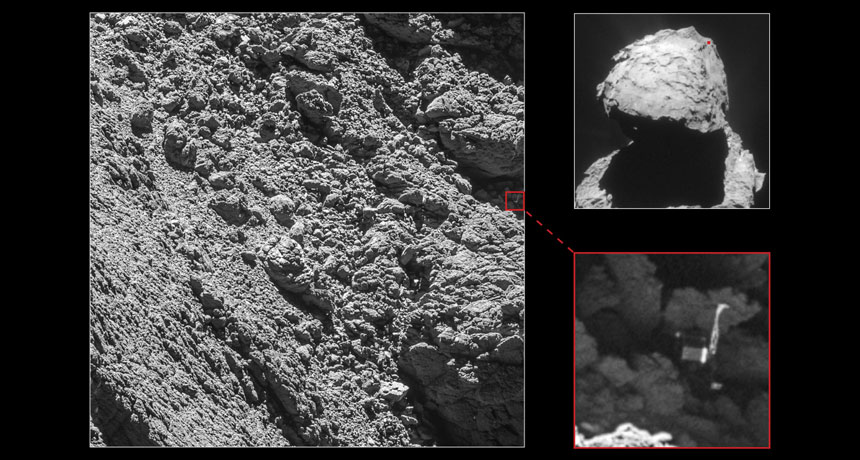
Philae has been found, nestled in a shadowy crevice on comet 67P/Churyumov-Gerasimenko. The comet lander, lost since its tumultuous touchdown on the comet on November 12, 2014, turned up in images taken by the Rosetta orbiter on September 2.
Philae is on its side with one leg sticking out into sunlight. Its cockeyed posture probably made it difficult for Philae to reliably get in touch with Rosetta, explaining why scientists had trouble reestablishing communication. The discovery came about a month before the end of the Rosetta mission; the orbiter was scheduled to land on the comet on September 30and then shut down.
Philae spent just a few days transmitting data from the comet’s surface (SN: 8/22/15, p. 13). It had a rough landing, bouncing twice before stopping. Sitting in the shadow of a cliff, Philae was unable to use solar power to recharge its battery. Rosetta picked up intermittent communication in June and July 2015. Since January, temperatures on the comet have been too chilly for Philae’s electronics; scientists stopped listening for radio signals in July.
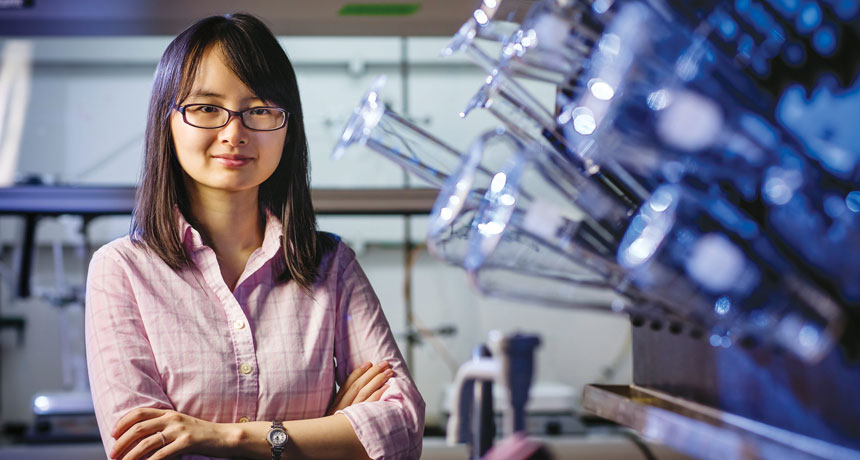
Qian Chen, 30 Materials scientist University of Illinois
The SN 10 In a darkened room, bathed in the glow of green light, materials scientist Qian Chen watches gold nanorods dance. They wiggle across a computer screen displaying real-time video from a gigantic microscope — a tall, beige tube about as wide as a telephone pole.
Chen has observed these and other minuscule specks of matter swimming, bumping into one another and sometimes organizing into orderly structures, just like molecules in cells do. By pioneering the design of new biologically inspired materials, she’s exploring what it means to be “alive.” Next, Chen wants to get an up-close and personal view of cellular molecules themselves: the nimble, multitasking proteins that work day and night to keep living organisms running.
At age 30, Chen is already racking up high-profile publications and turning some far-out ideas into reality. Her ultimate goal: To mimic the machinery that living cells have already perfected. To create life, or something like it, out of nonliving materials.
“If you can see it, you can start to understand it,” Chen said when I visited her lab at the University of Illinois at Urbana-Champaign earlier this year. “And if you understand it, you can start to control it.”
Chen didn’t always want to be a scientist. Growing up in China, she imagined one day becoming a writer. In middle school, she wrote an award-winning story about a girl who figures out how to repair the ozone layer. “My idea was to get some material that can be stretched, like the skin of the balloon,” Chen says. Her interest in inventing new and unusual materials took off years later, in the United States. After graduating from college in China in 2007 — Chen was the first in her family to do so — she headed to Illinois to work with materials scientist Steve Granick.
From the start, Chen stood out. “She made hard things look easy,” says Granick, now at the Ulsan National Institute of Science and Technology in South Korea. He recalls one experiment in particular, when Chen performed a feat some scientists thought impossible: She got thousands of tiny beads to form an open and orderly two-dimensional structure — all by themselves.
Chen had been studying colloidal particles, microscopic specks roughly a micrometer in size. People normally think of these particles as a component of paint, not all that interesting.
But Chen had the idea to cover the particles with a kind of sticky coating that acted something like Velcro. When the particles bumped into one another, they stuck together. At first, “It looked like a mess, like a failed experiment,” says Granick. “Most graduate students would have just chalked it up to a mistake and gone home.”
After a day of knocking around in solution, sticking together and tearing apart, the particles finally settled into something stable. The special coating and the way Chen applied it (capping the top and bottom of each particle) led to a “kagome lattice,” something sort of like a honeycomb. Never before had scientists coaxed colloidal particles into such an open, porous framework. Usually, the particles pack together more tightly, like apples stacked on the shelf at a grocery store, Chen says. That work led in 2011 to a publication in Nature: “Directed self-assembly of a colloidal kagome lattice.” A week earlier, Chen and Granick had published a different paper in Science, “Supracolloidal reaction kinetics of Janus spheres,” about particles that self-assemble into a twisting chain, or helix. At the time, Chen was 24.
“Her work is at the leading edge,” says Penn State chemist Christine Keating. “She’s so full of enthusiasm for science, and energy and creative ideas.”
Exactly how such particles might one day be used is still anybody’s guess. Some researchers envision self-assembling materials building smart water filters or adaptable solar panels that change shape in response to the sun. But the full range of possibilities is hard to fathom. Chen is “trying to invent the rules of the game,” Granick says. “She’s laying the groundwork for future technologies.”
Her next big focus will take her field from self-assembly 101 to the master class level, by mimicking how biological molecules behave. But first she has to see them in action.
Into the cell In 2012, Chen traveled west to the University of California, Berkeley to work with National Medal of Science winner Paul Alivisatos on a new microscopy technique.
Scientists today can view the details of proteins and DNA close up under a microscope, but the results are typically still-life images, frozen in time. It’s harder to get action shots of proteins morphing in their natural, fluid world. That view could unveil what roles different protein parts play.
Even a technique that won its developers a Nobel Prize in 2014 (SN: 11/2/14, p. 15) — it relies on fluorescent molecules to illuminate a cell’s moving parts — can’t always reveal the intricacies of proteins, Chen says. They’re just glowing dots under the microscope. Imagine, for example, looking at a dump truck from an airplane window. You can’t see how the truck actually works, how the pistons help lift the bed and the hinges open the tailgate.
“I use this as inspiration,” Chen says, grabbing her laptop and starting up a video that may well be the fantasy of anyone exploring biology’s secret world. The computer animation shows molecules whizzing and whirling deep inside a cell. Gray-green blobs snap together in long chains and proteins haul giant, gelatinous bags along skinny tracks. No one yet has gotten a view as clear as this hypothetical one, but a technique Chen is now helping to develop at Illinois could change that.
It’s called liquid-phase transmission electron microscopy, and it’s a slick twist on an old method. In standard TEM, researchers create subnanometer-scale images by shooting an electron beam through samples placed in a vacuum. But samples have to be solid — still as stone — because liquids would evaporate.
By sandwiching beads of liquid between thin sheets of graphene, though, Chen gets around the problem. It’s like putting droplets of water in a plastic baggie. The liquid doesn’t dry up, so researchers can observe the particles inside jittering around. Chen has used the technique to see gold nanorods assembling tip-to-tip and DNA-linked nanocrystals moving and rotating in 3-D. Now, she may be on the verge of a big advance.
With liquid-phase microscopy, Chen is attempting to see cellular machinery with a clarity no scientist has achieved before. She is cautious about revealing too many details. But if Chen succeeds, she may be on her way to cracking the code that links biological structure to function — figuring out the parts of a protein, the pistons and hinges, that let it do its specific job. Knowing the structural building blocks of life, she says, will help scientists create them — and everything they can do — out of artificial materials.
“We’re not there yet,” Chen says, “but that’s the big dream.”
A baby boy born on April 6 is the first person to be born from a technique used to cure mitochondrial diseases, New Scientist reports.
The child’s mother carries Leigh syndrome, a fatal disease caused by faulty mitochondria. Mitochondria generate most of a cell’s energy and perform other functions that keep cells healthy. Each mitochondria has a circle of DNA containing 37 genes needed for mitochondrial function. A mutation in one of those genes causes Leigh syndrome. The woman herself is healthy, but previously had two children who both died of Leigh syndrome.
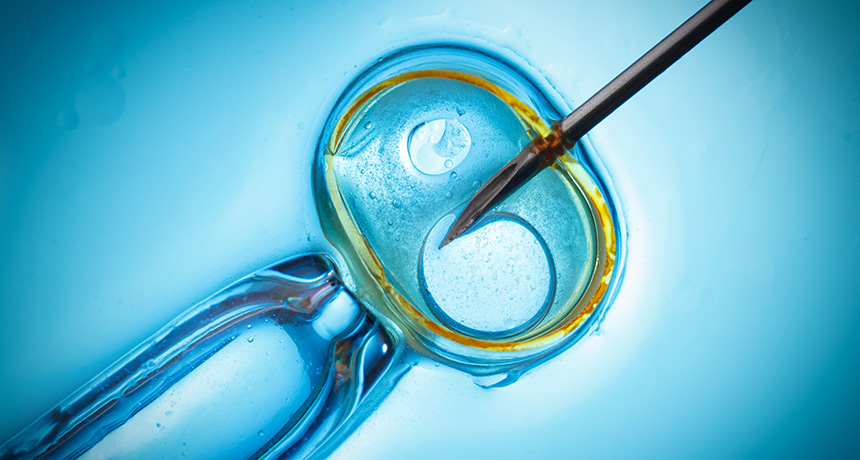
John Zhang, a fertility doctor at New Hope Fertility Center in New York City, and colleagues transferred a structure called the spindle with chromosomes attached to it from one of the woman’s eggs into a healthy, empty donor egg. The resulting egg was then fertilized with sperm from the woman’s husband. The procedure was done in Mexico.
The technique, called spindle nuclear transfer, is one of two ways of creating “three-parent babies” to prevent mitochondrial diseases from being passed on. Such three-parent babies inherit most of their DNA from the mother and father, but a small amount from the donor. Other three-parent children who carried mitochondria from their mothers and from a donor were born in the 1990s, but the baby boy is the first to be born using a nuclear transfer technique. Zhang and colleagues will report the successful birth October 19 in Salt Lake City at the American So
A GPS app can plan the best route between two subway stops if it has been specifically programmed for the task. But a new artificial intelligence system can figure out how to do so on the fly by learning general rules from specific examples, researchers report October 12 in Nature.
Artificial neural networks, computer programs that mimic the human brain, are great at learning patterns and sequences, but so far they’ve been limited in their ability to solve complex reasoning problems that require storing and manipulating lots of data. The new hybrid computer links a neural network to an external memory source that works somewhat like RAM in a regular computer.
Scientists trained the computer by giving it solved examples of reasoning problems, like finding the shortest distance between two points on a randomly generated map. Then, the computer could generalize that knowledge to solve new problems, like planning the shortest route between stops on the London Underground. Rather than being programmed, the neural network, like the human brain, responds to training: It can continually integrate new information and change its response accordingly.
The development comes from Google DeepMind, the same team behind the Alpha Go computer program that beat a world champion at the logic-based board game.
Clever chemistry could take the salt out of water softening.
Aluminum ions can strip minerals from water without the need for sodium, researchers report online October 4 in Environmental Science & Technology. The new technique could sidestep health and environmental concerns raised about the salt released by existing sodium-based water softening systems, says study coauthor Arup SenGupta.
“This is a global need that hasn’t been met,” says SenGupta, an environmental engineer at Lehigh University in Bethlehem, Pa. “We’re just changing the chemistry by adding aluminum ions, which is not something outlandish, but with that we can reduce the environmental impact.” Hard water contains dissolved minerals such as calcium and magnesium that make it harder for soap to lather and that can leave scaly deposits inside faucets and showerheads. Many water softening systems combat these problems by passing water through a special tank containing beads covered in sodium ions, charged particles that can swap places with the calcium and magnesium, resulting in softer water.
This technique adds extra sodium to the outgoing water, though, which can raise blood pressure when used as drinking water (SN Online: 3/12/14). The system also has to be recharged periodically using a sodium-rich brine. That extra salt can end up in local groundwater and streams, prompting bans on salt-based water softeners in many areas, including many counties in California. While some sodium-free substitutes exist, many are expensive while others are “snake oil” and don’t actually work, SenGupta says. He and colleagues decided to try aluminum, a counterintuitive choice based on its chemistry. An aluminum ion has a net positive charge of three, meaning that it has three fewer negatively charged electrons than a neutral aluminum atom. That charge difference makes it less likely for aluminum to swap places with a calcium or magnesium ion, which each have a positive charge of two. But when an ion exchange does happen, the aluminum often quickly precipitates back onto the water softener’s beads rather than dissolving into the water and being swept away. The process allows the same aluminum ion to swap in for multiple calcium and magnesium ions. Setting up a prototype water softening system in the laboratory, the researchers successfully reduced the amount of calcium and magnesium in a groundwater-like mixture using aluminum ions. Recharging the system also resulted in fewer wasted ions than sodium-based systems, the researchers found, lowering the potential environmental impact. The process uses a similar setup to sodium-based systems, SenGupta says, meaning existing systems could be easily retrofitted to use aluminum ions.
While an exciting idea, the new design might not work as well in real life as it does in the lab, says Steven Duranceau, an environmental engineer at the University of Central Florida in Orlando. Bacteria and other substances in groundwater can reduce effectiveness, and strict guidelines surrounding drinking water could prove an unsurmountable hurdle, he says. “I see these great things all the time, but a lot of them just don’t make it financially.”
SenGupta remains optimistic, though. “This is not a magic bullet; there are shortcomings, but none of these problems are impossible to overcome.”
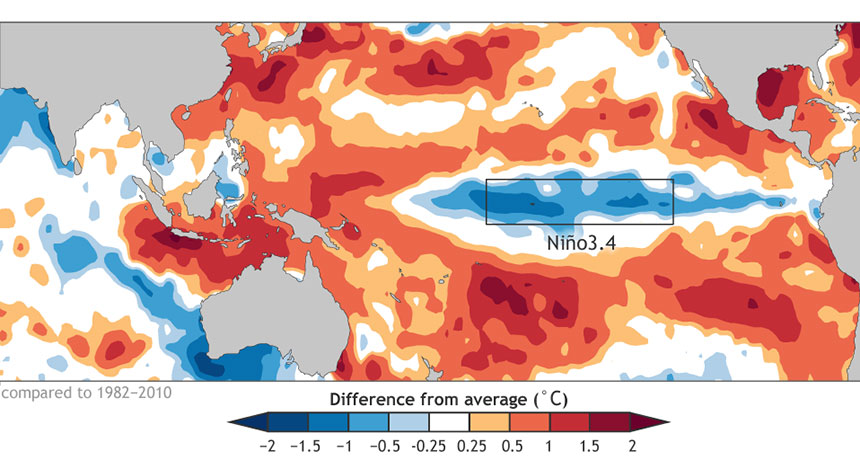
El Niño’s meteorological sister, La Niña, has officially taken over.
This year’s relatively weak La Niña is marked by unusually cool sea surface temperatures in the central and eastern equatorial Pacific Ocean. That cold water causes shifts in weather patterns that can cause torrential downpours in western Pacific countries, droughts in parts of the Americas and more intense Atlantic hurricane seasons.
The event has about a 55 percent chance of sticking around through the upcoming Northern Hemisphere winter and is expected to be short-lived, the National Oceanic and Atmospheric Administration’s Climate Prediction Center reported November 10.