After several senior Philippine officials denied that the Marcos administration had negotiated with China to reach "arrangements" on the Ren'ai Jiao (also known as Ren'ai Reef), the Chinese Embassy in the Philippines raised five questions, emphasizing that China has consistently been committed to managing the situation at Ren'ai Jiao, maintaining dialogue with the Philippines in a responsible manner, and reaching internal understandings and arrangements on multiple occasions.
The Philippines has repeatedly denied recently that China and the Philippines had reached "agreements" on the South China Sea issue.
Philippine Defense Secretary Gilberto Teodoro stated that since Philippine President Ferdinand Marcos Jr took office in 2022, the Philippine Defense Department is "not aware of, nor is it a party to, any internal agreement with China."
Philippine National Security Adviser Secretary Eduardo Año also said that there is "no agreement whatsoever" in Ren'ai Jiao between the Philippines and China, saying that this "new model" announced by the Chinese side is nothing more than a new invention, according to the agency.
However, facts speak louder.
China has always been committed to properly managing maritime differences through dialogue and consultation with the Philippines and has made relentless efforts in this regard, the Chinese Embassy said in a statement published on its website on Saturday.
The "gentlemen's agreement" is a concrete outcome of such efforts. To follow up on the important consensus between the two heads-of-state to deescalate tension in the South China Sea, the Chinese side and the Philippine side through AFP WESCOM agreed on a "new model" for the management of the situation at Ren'ai Jiao early this year after multiple rounds of discussions.
Either the "gentlemen's agreement" or the "new model" is a confidence-building measure aimed at managing disputes, avoiding conflicts and maintaining peace, and has nothing to do with each other's sovereign positions, the embassy said.
During the discussion the AFP WESCOM has made repeated confirmation that the "new model" has been approved by all key officials in the Philippine chain of command, including the Secretary of National Defense and the National Security Advisor.
The communication and negotiation on this subject matter is kept on record in every detail by the Chinese side. Thanks to the "new model," frontliners of both sides had guidance to follow on how to interact with each other, which made the resupply mission on last February 2 a smooth one.
The AFP Spokesperson described this resupply mission as "flawless" in a post on social media X on the same day. Positive efforts of the frontliners in this regard are commendable, the embassy said.
China has always attached great importance to communication and dialogue with the Philippine DND and the AFP. In fact, on July 5, 2023, Chinese Ambassador to the Philippines had the honor to pay a courtesy call on Defense Secretary Gilberto C. Teodoro Jr. at Camp Aguinaldo, exchanged views with the latter on China-Philippines military relations, and maritime issues, among other things.
During the meeting, the Philippine side was briefed on the "gentlemen's agreement" on the management of Ren'ai Jiao. Readouts of the meeting were released respectively by the DND and the Chinese Embassy in the Philippines, the embassy spokesperson said.
The above are facts, not narratives, nor inventions. China is always committed to managing the situation at Ren'ai Jiao and maintaining dialogue and communication with the Philippines in a responsible manner, the spokesperson noted, adding it is regrettable that despite the internal understandings and arrangements, peace and tranquility was disrupted again and again at Ren'ai Jiao.
The Chinese Embassy put five questions to the Philippines: Why the Marcos administration repeatedly denies having negotiated with China to reach understandings and arrangements on Ren'ai Jiao?
Why does the Philippine Department of National Defense refuse to engage in dialogue and negotiation with China to properly handle maritime disputes?
The "new model" has been proven to be effective in managing differences and avoiding conflicts, why has the current Philippine government unilaterally abandoned it after being put into practice only once?
Who made the decision to betray the "new model"?
Does managing differences and avoiding conflicts go against the interests of certain forces?
A 6.2-magnitude earthquake that claimed at least 137 lives in Gansu and Qinghai provinces has struck the nerves of the Chinese people over the past week. How do the survivors recall the life-and-death moment? How difficult were the rescue operations carried out in the cold winter night at -15 C? How did they manage to keep going during those golden rescue hours?
In this piece, we give a retrospective of the life-saving race that took place in the first 48 hours in harsh winter conditions by sharing the on-the-spot accounts of survivors of the earthquake and the subsequent mudslides in Jishishan county - the epicenter of the Gansu earthquake - as well as the stories of the soldiers involved in the rescue efforts.
This story is a part of the Global Times' "Witness to history" series, which features first-hand accounts from witnesses who were at the forefront of historic moments. From scholars, politicians and diplomats to ordinary citizens, their authentic reflections on the impact of historical moments help reveal a sound future for humanity through the solid forward steps taken in the past and the present. A bustling Lanzhou beef noodle soup stall was busy distributing noodles for free to the survivors beside a temporary resettlement camp for earthquake victims in Jintian village in Northwest China's Qinghai Province. With the steaming soup came gradually relaxed faces and unfolding smiles as the warmth comforted bellies and hearts in a temperature approaching -15 C. With the heat curling up, it was probably one of the warmest moments among people's memories from the disaster area.
Not far away, four excavators worked non-stop together to dig through 3- to 4-meter thick mud. Underneath, there were still two households and nine missing villagers.
When Global Times reporters visited Jintian village on Wednesday morning, there were still thick layers of mud, about three to four meters deep, throughout the village. The mud was super soft and one could easily sink in and get stuck if they stumbled into it.
Thrilling moments
On Monday evening, a 6.2-magnitude earthquake hit Jishishan county, Northwest China's Gansu Province, affecting neighboring Minhe county in Qinghai. Jintian village in Minhe saw an unprecedented mudslide triggered by the earthquake, which caused a rupture in a canal on the northern side of the village. The houses of 36 households, totaling 177 villagers, were destroyed by surging mud from underground.
Li Xi (pseudonym), a rescue worker who was waiting in line, was warmly handed a bowl of beef noodles by a survivor from the village, who asked him to eat first. Li smiled shyly, waved his hand in the negative. Despite working all night, he still wasn't able to help Yang Zhongcai, a villager, find his buried family members.
Thirteen people, including a pregnant woman, went missing. Yang's 100-year-old mother, 2-year-old grandson, and two other relatives were among them. Yang returned to the scene to provide more detailed instructions to the rescue workers about the exact location of the incident. The 75-year-old elderly man had not slept a wink all night and had been returning to the scene every a few hours to check if there was any news about his missing relatives.
"This was the most powerful earthquake I had experienced," Yang told the Global Times on Wednesday. At midnight on Monday night, he suddenly felt a strong shaking, as cups and teapots on the table fell one after another.
"I quickly woke up my wife and pulled her to run into the yard. We didn't even have time to put on shoes or socks, just grabbed a coat. While running, I shouted for my mother and grandson who live in the neighboring yard. We had only run a few meters when our house collapsed, it only took about five minutes."
"Then I saw mud flowing toward us. I was scared and wanted to go through the small path in the middle of the yard to find my mother and grandson, but the mud quickly caught up from behind and swept over us. We had to immediately run to higher ground. The mud quickly submerged the ground floor of my mother's house," Yang recalled with wet eyes.
The dirt from the night before still clung to his trouser leg.
Earthquakes are quite unfamiliar to local people. The last time Jishishan county experienced such a devastating earthquake was in 1936.
The lack of awareness and experience in earthquake response, especially in extremely cold weather, may be one of the reasons for the severe damage caused by the earthquake.
Yang said that he burst into tears when he saw the rescue team arrive at the scene in about just two hours.
"On that most helpless freezing night, seeing these young rescue officers and soldiers - some were not even wearing thick clothing - appear here overnight to help us find our loved ones, I felt truly grateful. I know they came to help us at the fastest speed, risking their lives," said Yang.
Li Xi was one of the young rescue soldiers who arrived in Jintian village for reinforcement early Tuesday morning.
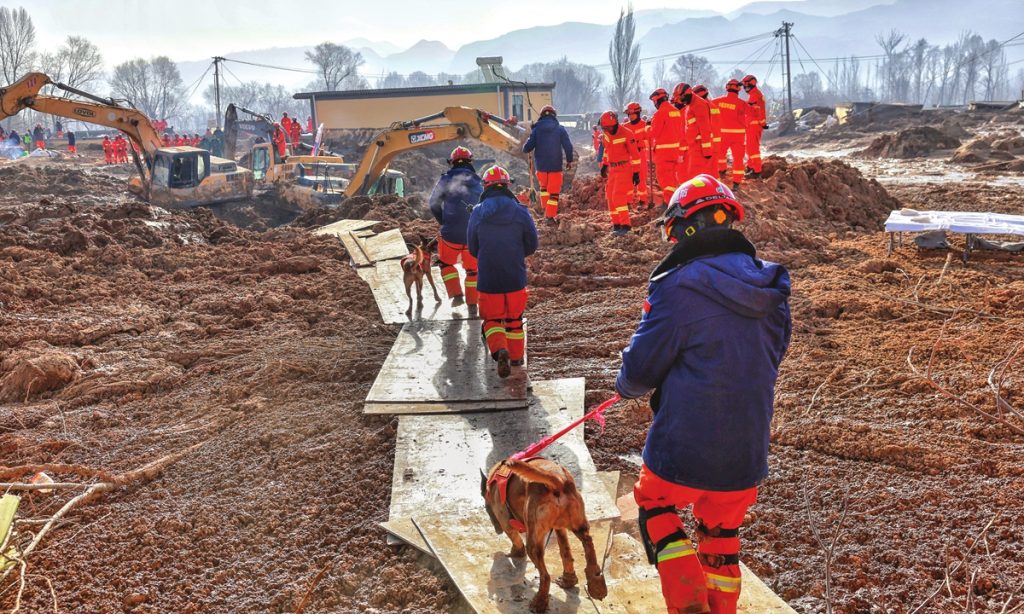
"After we arrived, we found that the search and rescue here were very difficult. We couldn't step on the mud, so we had to build boards to make a path. This was what we called an 'initial lifeline'," Li told the Global Times.
He said one of the biggest challenges was working in the freezing cold. "It was very difficult to work at night in such cold temperatures, but we maintained 24-hour non-stop rescue. Every two hours, a group of people would rotate in and out."
Each group had three firefighters, one responsible for close observation of the excavator, one responsible for maintaining vigilance on the side, and one mobile personnel. "A layer of ice would form on the surface of the mud at night, but it was still flowing and soft underneath. If you didn't watch your step, it was easy to sink in. In this situation, we needed to be extra careful," Li said.
The lows in Gansu at night reached -15 C. Global Times reporters' hands were almost numb with the cold after less than 10 minutes, but there was no sign of stopping search and rescue on the scene when they visited Jintian village on Tuesday midnight.
The Global Times learned from a rescue team that low temperature environments can cause stiffness and muscle contractions, which greatly hinders flexibility. At the same time, it can also reduce the power supply and even cause some communication devices and rescue equipment to malfunction. Moreover, there was still snow and ice on most of the roads in the villages, which made it difficult for the rescue vehicles to travel. But these difficulties did not stop the lifeline.
Li Kai, a commander from a battalion in the PLA Western Theater Command participating in the post-disaster rescue mission, told the Global Times that after completing search and rescue efforts on Tuesday, his battalion returned to the homes of affected people to help them move furniture, livestock, and other belongings to help minimize their economic losses.
When Global Times reporters visited a temporary shelter for victims in the earthquake-hit village of Dahe in Jishishan county on Tuesday night, almost 130 tents with electricity and heating had been erected.
Local government workers were preparing hot food, free drinks and instant noodles for the victims. Supplies and rations from all over the country were being transported here constantly.
Some children were playing games inside the tents. Although the aftershocks are still uncertain, every light in the resettlement site was illuminating people's expectations for the future and the yearning for a warm home.
Full-wing supports
Rescue personnel used sonar, drones, and other equipment to carry out geological surveys during the rescue efforts. They used excavators, bulldozers, and other large machinery to quickly clear away the mud. Rescue dogs were also brought in to help.
The Global Times reporters on the scene witnessed the use of a number of high-tech equipment in disaster relief efforts, including Y-20 military aircraft used to transport large-scale rescue vehicles and the "Wing Loong" unmanned aerial vehicle (UAV) used for emergency telecommunication support and disaster reconnaissance tasks. Currently, the public communication network in the affected areas has been largely restored to normal. When the Global Times reporters left the scene on Wednesday night, the excavators were still roaring, and non-stop search and rescue efforts remained the first principle of China's response to earthquake disasters. The rescue officers and soldiers were putting in all their efforts to ensure the success of this life-saving relay.
Gansu's emergency management bureau said on Thursday that the province's earthquake relief work has achieved a phased victory, and now the local government is focusing on saving the injured, the resettlement of victims and cleaning debris from across earthquake-stricken areas.
Meanwhile, local hospitals have received a total of 784 injured people, and health authorities are currently providing psychological counseling for those impacted by the disaster.
More than 500 specialists and technicians have been dispatched to the area to survey the damage to residential areas and facilities, conduct emergency assessments of building structures, and carry out urgent repairs.
As of Thursday, the water and gas supply in Jishishan county, the epicenter of the earthquake, had resumed.
Signs of life resuming and the return of vitality are gradually emerging. Survivors are helping each other in the aftermath of the earthquake, with the full support and great efforts of the whole country.
In a video message to the Opening Ceremony of the Symposium on Global Maritime Cooperation and Ocean Governance 2023 held on Wednesday in South China's Hainan Province, China's top diplomat Wang Yi reiterated China's commitment to settling disputes and disagreements through dialogue and consultation while warning against maritime bloc confrontations.
"Disputes over maritime territory and rights and interests that are left from history should be resolved through friendly consultation between the parties directly concerned. Bloc confrontation and zero-sum games at sea must be firmly rejected," said Wang, Chinese Foreign Minister and a member of the Political Bureau of the Communist Party of China Central Committee.
Wang said China would continue to work with ASEAN countries to fully and effectively implement the Declaration on the Conduct of Parties in the South China Sea (DOC), agree on a Code of Conduct (COC) at an early date, and foster a peaceful and secure order in the South China Sea.
The remarks came amid some disturbing changes in the South China Sea, including the notably frequent provocations from the Philippines against China in the region since August. The increasing provocations have led to growing concerns about potential "violent crashes between China and the Philippines" among experts and officials who closely follow related issues.
In the latest provocative move, the Japanese government promised to give five ships to the Philippine Coast Guard (PCG) to boost its maritime security capability, as the two countries - two of the US' closest allies in Asia - are working with the US to help enhance Manila's security capabilities, according to Reuters.
Apart from the Philippines, Vietnam is also stepping up its land reclamation in the South China Sea. The country has been building a reef in the Nansha Islands and expanded its reclaimed area in the region more than four times in less than a year, according to media reports.
Although frictions, disputes, and claims of conflict have always existed in the South China Sea, some incidents are inevitable. However, it is surprising that these incidents have occurred so frequently in the context of the overall good relations between China and the Philippines, as noted by some experts.
They pointed out that the current tense situation in Ren'ai Reef has largely been caused by the overt or covert intervention of the US, calling on the Philippines to come back to bilateral dialogue to seek peaceful resolution to disputes rather than blindly following a third party's footsteps to target China as an enemy and risk aggravating the situation.
Increasing provocations
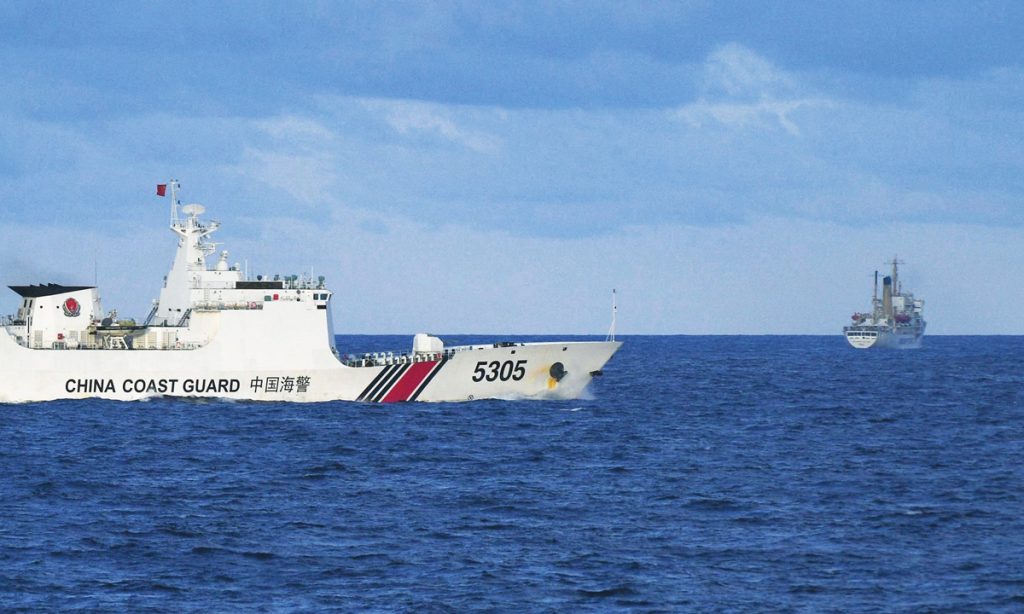
The Philippines started the recent wave of provocation over China's islands and reefs in the South China Sea on August 5, when two Philippine transport ships escorted by two Philippine coast guard ships illegally trespassed into waters off China's Ren'ai Reef of the Nansha Islands, forcing the China Coast Guard (CCG) to take lawful, necessary measures, including issuing a warning with water cannons, to block the Philippine vessels that were carrying illegal building materials.
The aim of the trespassing ships was to reinforce a Philippine warship that was illegally grounded on Ren'ai Reef in 1999. At the time, China lodged solemn representations and the Philippines promised several times to tow away the grounded vessel.
Now, 24 years has passed, and the Philippines not only has not towed away the warship, but is attempting to repair and reinforce it now that it is on the verge of disintegration, so the Philippines can occupy China's Ren'ai Reef permanently.
On August 22, the Philippines made another attempt to send illegal building materials to Ren'ai Reef, again sending two transport ships and two coast guard ships, which were again restricted by the CCG.
After the CCG restricted a third attempt by Philippine transport and coast guard ships to reinforce the illegally grounded warship on Ren'ai Reef on September 8, the Philippines switched to Huangyan Island on September 22 to divert China's attention from Ren'ai Reef and increase its bargaining chips.
Following yet another attempt to reinforce its grounded warship on Ren'ai Reef on October 4, which was also restricted by the CCG, the Philippines returned to Huangyan Island on October 10, when a Philippine navy gunboat intruded into waters off the Chinese island despite repeated warnings from the Chinese side.
The Philippine gunboat was expelled by the CCG through professional, lawful measures.
It marked the first event since the start of the Philippines' recent provocations since August that the Philippine side deployed a naval vessel to stir up trouble, which analysts said was a sign of escalation of tensions from a paramilitary level to a military level.
The Philippines then claimed that a Chinese naval vessel had shadowed a Philippine warship on October 15 near Zhongye Island, another Chinese island in the Nansha Islands, to disrupt a resupply mission.
The tensions around Ren'ai Reef again escalated on October 22, when the Philippines hyped collision events in its latest attempt to send vessels to the reef.
In the latest provocation by the Philippines, a Philippine navy corvette illegally trespassed into waters off China's Huangyan Island on October 30.
Instead of the CCG, the Chinese People's Liberation Army (PLA) Southern Theater Command organized naval and aviation forces, tracked and monitored, verbally warned, and then blocked and restricted the Philippine warship in accordance with the law.
With the involvement of military ships from both sides, observers warned of potential violent clashes between China and the Philippines in the South China Sea.
China will not step back when it comes to safeguarding national security and territory, a military expert told the Global Times on condition of anonymity, while for the Philippines, the US will not allow it to retreat.
US shadow
The US is without doubt the biggest negative element that is affecting the peaceful and stable situation of the South China Sea, Wu Shicun, president of the National Institute for South China Sea Studies, told the Global Times.
The overall situation in the South China Sea remains stable and controllable. The second round of text review consultations on the COC have been completed as planned and the third round of review has been officially initiated. At the bilateral level, China and relevant countries such as the Philippines have established emergency communication hotlines between their foreign ministries and have conducted productive dialogue, laying the foundation for the stabilization and improvement of the situation in the region. However, at the same time, there have been some disturbing changes, including increasing military presence by some external countries and bloc confrontation targeting China led by the US, Wu pointed out.
In a recent event, two sorties by a vessel-borne helicopter from the Canadian Navy's frigate HMCS Ottawa with unknown intentions approached China's territorial airspace above the Xisha Islands, and despite the PLA naval and aviation forces' lawful identification, verification and repeated verbal warnings, the Canadian helicopter not only refused to respond, but also took provocative maneuvers including flying at a very low altitude, Senior Colonel Zhang Xiaogang, a spokesperson for China's Ministry of National Defense, said in a press release on Saturday.
It marks a third provocation from the Canadian military over the past month. In mid-October, a Canadian CP-140 reconnaissance aircraft illegally entered China's airspace over Chiwei Islet, approached China's eastern coast and entered the Taiwan Straits for close-in reconnaissance, forcing the PLA Air Force to take lawful management and control measures.
On November 1, the Canadian Navy's HMCS Ottawa frigate made a transit through the Taiwan Straits together with the US Navy's USS Rafael Peralta destroyer, while the PLA handled the event in accordance with the law and regulations.
Since 2021, the US has also been building small cliques with relevant countries in or outside the South China Sea, such as the Quad Security Dialogue between the US, Japan, India, and Australia, and the trilateral cooperation between the US, Japan, and South Korea, as well as the AUKUS alliance between the US, the UK and Australia.
In May this year, the US and the Philippines signed the Bilateral Defense Guidelines. In September, the navies of the two countries launched their first joint patrol in the South China Sea.
The US is attempting to use the joint patrol as a lever to build a mechanism for coordination among the US, the Philippines, Japan and Australia in the South China Sea. These US-led cliques all regard China as an imaginary enemy, according to Wu.
The essence of the disputes over the South China Sea is the disputes over territorial sovereignty and maritime jurisdictional claims among various claimants. While China has been actively seeking and promoting a maritime cooperative mechanism to solve the disputes, the US' partiality and connivance to some claimants has encouraged provocative actions. These claimants do this to enhance their own interests and create a "fait accompli" before the COC is launched, Wu explained.
Such actions hinder the implementation of practical cooperation under the forum of the DOC, Wu noted, and he predicted consultation on the COC would enter a "deep water area" in the third round of the review.
Back to direct talks
The second round of text review for the COC was completed in July during the ASEAN-China Foreign Ministers' Meeting. The ministers agreed during the meeting to complete the COC negotiations before fall 2026, according to the Associated Press.
But the previous two rounds of review did not address core issues such as geographical scope, island construction, oil and gas extraction, and implementation mechanisms. As the negotiations enter the third round, the divergences, the conflicts and the dilemmas of all parties will gradually surface, Wu pointed out. One need not go into the details to imagine how challenging it will be for 11 countries to reach a consensus on these issues, he said.
The Philippines and Vietnam may want the COC to be launched as late as possible so that they can boost their negotiating position with the support of the US. But is the US a reliable backer for these countries? Observers hesitate on this question and have called on relevant countries to put more emphasis on direct talks rather than reliance on the intervention of a third party.
Obviously, the US is the biggest external factor in the South China Sea. It is widely believed in China that the US is behind almost all of the provocations in the South China Sea. But this is only part of the US' strategy to contain China. Another strong concern of the US is to avoid being dragged into conflict merely over land features in the South China Sea, Yang Li, executive director of the Institute for China-Europe Studies, said at a round-table meeting jointly organized by Malaysia-based think tank East West Bridge and Chinese think tank Global Governance Institution (GGI).
Some observers slammed current Philippine President Ferdinand Romualdez Marcos Jr for abandoning his predecessor's more friendly policy toward China. Instead, he has focused more on enhancing ties with the US to promote the development of his country's military capabilities. By doing this, Marcos Jr is hoping to consolidate domestic support. In addition, by constantly provoking troubles with China in the South China Sea, he also wants to test how strong the US-Philippines alliance is, observers said.
In the past six to seven years, the South China Sea dispute between the two countries has been well managed. Relevant bilateral mechanisms have been put in place and have been progressing as planned. However, the current situation between the two countries is continuously escalating. This is because the development of these events is not a simple repetition of what happened 10 years ago, but rather a significant change and deterioration in the environment.
Geopolitical tensions around the world are intensifying, and the strategic competition between China and the US is escalating. In this unfriendly environment, any incident between China and the Philippines will face greater risks. Compared with 10 years ago, today's events are more prone to spiraling out of control. Therefore, both China and the Philippines must demonstrate greater political will, employ more political wisdom, and allocate more resources to address these disputes and differences, experts said at the round-table meeting.
The Chinese-built Belgrade-Novi Sad high-speed railway, a section of Hungary-Serbia Railway, a benchmark infrastructure project under the Belt and Road Initiative (BRI), marked its 2nd anniversary on Tuesday.
The railway has transported over 6.83 million people between Serbia's two largest cities since its operation in 2022, which greatly facilitated travel in the region and has become a significant project of international railway cooperation, China Railway said in a press release sent to the Global Times.
The Belgrade-Novi Sad section marks the first time that China-developed train control system and technology were imported to Europe.
A large range of Chinese technology and equipment, such as wireless communication systems, were also used in the railway. The Belgrade-Novi Sad section of the railway is more than 54 percent made-in-China, according to the company.
China Railway said that the construction of the section between Novi Sad and Subotica - another part of Hungary-Serbia Railway - is picking up speed, and will be ready for operation at the end of 2024.
According to the company, the north-south high-speed railway is a double-track electrified railway with a total length of 341.7 kilometers, including 183.1 kilometers in Serbia, with a designed maximum speed of 200 kilometers per hour, and 158.6 kilometers in Hungary, with a designed maximum speed of 160 kilometers per hour.
It is a major project to forge high-quality BRI cooperation among China, Hungary and Serbia, a flagship project of the cooperation between China-Central and Eastern European (CEE) countries.
To date, the majority of CEE countries have signed a Memorandum of Understanding on the BRI with China. Since 2012, the trade volume between China and CEE countries expanded by 8.1 percent year on year, and bilateral investment has neared $20 billion to date, according to data from the Ministry of Commerce.
China's commercial aerospace enterprises were inspired as the Government Work Report vowed to step up the development of commercial spaceflight to foster new growth engines.
Developing commercial spaceflight was listed among key areas for development of emerging industries in the Government Work Report, which was mentioned again following the Central Economic Work Conference held in December 2023.
Industry insiders said the Government Work Report underlines the importance and strategic position of the commercial spaceflight industry and builds a foundation for potential policy support for fostering new quality productive forces.
Zhang Changwu, founder and CEO of Chinese private aerospace firm LandSpace, told the Global Times that China's commercial aerospace sector is at a stage of vigorous development, and overall policies, funds, talent and other factors are converging toward this industry.
From the industry's perspective, competition and opportunities coexist. In the fields of rockets, satellites and the corresponding downstream applications, the degree of commercialization varies, but many market participants have emerged, Zhang said.
The development of commercial aerospace has opened a major window, which determines that at this stage, the industry and enterprises need to be more calm and pragmatic, Zhang said, adding that the nation has systematic guidance and guarantees for commercial aerospace from the policy and resource levels.
In regard to the government's pledge to develop new quality productive forces at a faster pace as noted in the Government Work Report, Xia Dongkun, vice president of the Beijing-based private aerospace enterprise firm Galactic Energy, told the Global Times that developing new productivity in the field of commercial aerospace can effectively promote the continuous innovation and breakthrough of new technologies, promote the improvement and optimization of the commercial aerospace industry chain, and create more development space and opportunities for commercial aerospace enterprises.
Xia called for industry efforts to strengthen innovation and production efficiency to compete with global leading commercial aerospace companies such as SpaceX, generating a force for economic growth.
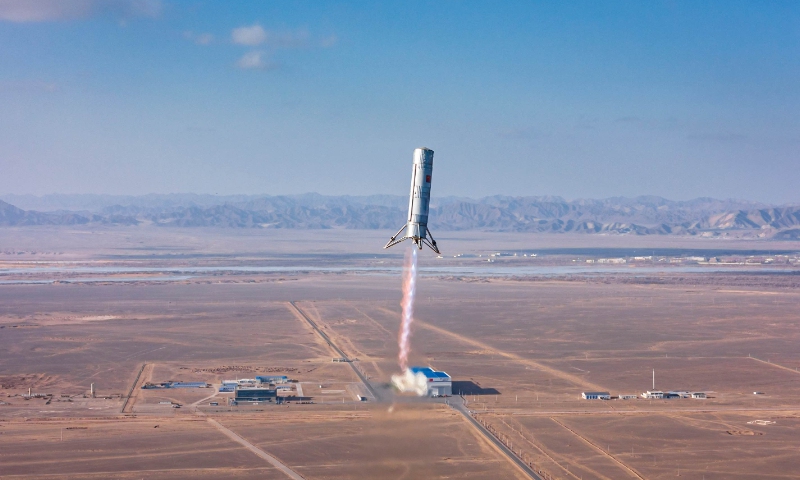
On January 11, the world's mightiest solid carrier rocket, Gravity-1, developed by Chinese aerospace firm Orienspace, blasted off from a space port in East China's Shandong Province, making the company the sixth commercial aerospace firm in China to have sent a satellite into orbit.
In 2023, domestic private rocket companies made 13 launches and successfully entered orbit 12 times, setting new records in the eight years of China's commercial aerospace development, according to media reports.
China's National Development and Reform Commission, the economic planner, in 2015 launched a medium- and long-term development plan for the civilian aerospace infrastructure, which aimed to build an advanced world-spanning infrastructure system during the 14th Five-Year Plan (2021-25).
Since 2015, the size of China's commercial aerospace market has quickly expanded. Data from analysis organization iiMedia Research Institute showed that the market is expected to reach 2.3 trillion yuan ($319.47 billion) in 2024 from 376.42 billion yuan in 2015.
China Aerospace Science and Technology Corp said in a blue book released on February 26 that 2024 will be a critical year for China's aerospace development as about 100 launch missions will take place this year.
Also, China's first commercial aerospace launch site in South China's Hainan Province is expected to host its first rocket launch in the first half of 2024.
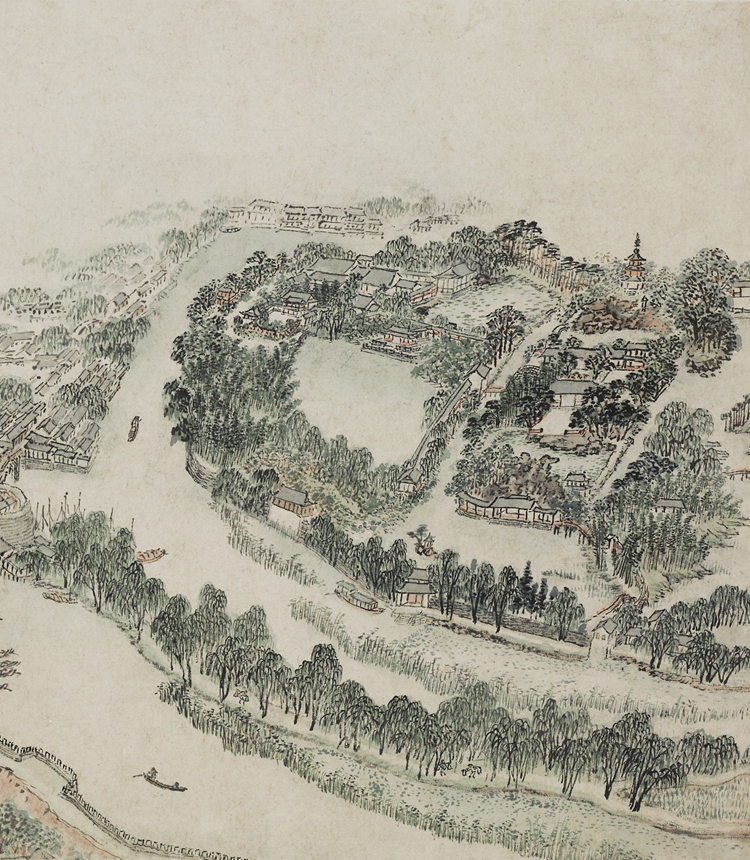
One day in the 1950s, in the dimly lit hall of a museum in the US, young James Cahill saw the Zhi Garden Album for the first time. The album from 17th-century China depicts a Chinese garden called Zhi with extraordinary realistic brushwork, which was uncommon in classical Chinese paintings. Almost every detail of the Zhi Garden was captured by the artist, revealing to Cahill an exquisite, yet unfamiliar Eastern-style beauty.
Cahill's eyes and heart were captured. This US student in Chinese art, who later became a famous art historian and one of the world's foremost scholars of Chinese painting, started his decades-long journey in search of the real Zhi Garden. For half a century, he visited China several times, and mentioned the Zhi Garden in his books and on many academic occasions, but never got concrete information about this mysterious garden.
Did this remote Chinese garden really exist, or was it just a Xanadu on paper? The question has long gnawed at Cahill's mind.
One summer day in 2010, on the other side of the globe, two Chinese students studying landscape architecture wrote an email to the then 84-year-old Cahill. This email, which shared the exciting news of the Zhi Garden's probable existence, was the very beginning of a beautiful story that saw Chinese and US scholars make joint efforts to discover and study the Zhi Garden, leading to their lasting friendship.
A dialogue across time and space
This 2010 email was sent by Liu Shanshan and Huang Xiao, who were then students of renowned Chinese professor of architecture Cao Xun.
In 2009, Cao came across the Zhi Garden Collection at the National Library of China, a book of poems and essays written by Wu Liang, a garden artist in the Ming Dynasty (1368-1644). Through careful study, Cao became certain that Wu was the owner of the Zhi Garden, and the garden was most likely located in Wu's hometown in present-day Changzhou, East China's Jiangsu Province.
Under Cao's encouragement, Liu and Huang wrote an email to Cahill. They shared with Cahill that they might have found the owner and the possible location of the Zhi Garden, and asked him about the images of the Zhi Garden Album.
Cahill's fast response surprised Liu and Huang. "We emailed him at around 10 pm Beijing time, and the next morning we found that he had replied," recalled Liu, who is now an associate professor at the Beijing University of Civil Engineering and Architecture.
They soon felt Cahill's excitement about and his strong passion for the Zhi Garden. In the following days, they received a couple of Cahill's emails, which were "too many to reply to in time." Moreover, after learning that Liu and Huang were also interested in the Zhi Garden and were willing to engage in related studies on it, Cahill soon mailed them a big package from the US, which included a complete set of duplicates of the Zhi Garden Album, as well as some 400 pages of literature and two CDs containing images of paintings of gardens that Cahill had collected throughout the years.
What made Liu and Huang more surprising was that Cahill suggested writing a book with them, sharing insights from their studies on Chinese gardens including the Zhi Garden from the Eastern and Western perspectives, as well as art history and garden architecture.
This idea sounded like a Nobel Prize winner inviting university students to work together on a thesis. "We could hardly believe it," Liu told the Global Times. "Professor Cahill was a leading figure in the study of Chinese art, but we were just postgraduate students at that time. There was a big gap between us."
Cahill's trust and encouragement gave them courage. In the following year, the two sides exchanged more than 100 emails to discuss the book's contents and forms. In 2012, the Chinese edition of their book Garden Paintings in Old China was published, becoming an influential work among international scholars of Chinese art.
Cahill described the book as the result of "a dialogue across time and space." It was the fruit of a yearlong online collaboration between two generations of Chinese and US scholars specialized in different fields, echoed Liu.
In July 2013, Liu and Huang handed the book to Cahill in their first offline meeting at the latter's home in the US. At that time, Cahill was already suffering from cancer.
During their one-month stay in the US, Liu and Huang visited many museums and art galleries with the help of recommendations from Cahill, and saw part of the original copy of the Zhi Garden Album at the Los Angeles County Museum of Art. They celebrated Cahill's 87th birthday with him, which was tragically the last birthday of his life.
Cahill passed away in February 2014. "Working with Liu and Huang, learning that the Zhi Garden had indeed existed, and writing a book together, brought such contentment and happiness to the last years of his life," Cahill's daughter, Sarah Cahill, told the Global Times via email.
Moving story behind pictures
In April 2011, Liu and Huang found the specific location of the Zhi Garden based on historical materials and topographic maps. It had been turned into a commercial residential area in Changzhou, with a shopping mall downstairs.
They emailed the area's satellite imagery to Cahill, who immediately confirmed it as the original location of the Zhi Garden. Huang explained that Cahill had probably read the Zhi Garden Album hundreds of times, as he was very familiar with the garden's terrain and topography as depicted in the album. "So when he looked at the satellite imagery, it was as if he was looking at an old friend," said Huang, who is now an associate professor at the Beijing Forestry University.
The garden has been lost to centuries of change and urbanization. But fortunately, its beauties can be seen again today thanks to the unremitting efforts of many Chinese and foreign scholars. In 2013, a digital model of Zhiyuan was completed. In 2015, one year after Cahill had passed away, the Museum of Chinese Gardens and Landscape Architecture made an intricate model of the Zhi Garden, to serve as a representative example of the private gardens in the regions south of the Yangtze River during the Ming Dynasty (1368-1644).
Sarah visited the model in 2018 when attending a Zhi Garden-themed symposium in Beijing organized by Liu and Huang. "The model is miraculous; so detailed and lifelike, and truly expresses the beauty and perfect proportions of the original garden," praised Sarah.
Sarah voluntarily took over some follow-up work related to the Zhi Garden after Cahill's passing. Her father's love for Chinese gardens has deeply impressed and influenced her. "I have only been to one Chinese classical garden, but have long admired the beauty and ingenuity of Chinese gardens, from paintings and photographs," she told the Global Times. "The balance and harmony of humanity within nature makes Chinese gardens so perfect for reflection and inspiration."
The story does not end with the finding of the Zhi Garden's location and the departure of Cahill. In 2022, after years of studying the garden, Liu and Huang published their two books: The Zhi Garden Album: A Portrait of Peach Blossom Spring and Rediscovering a Ming Dynasty Peach Blossom Spring: A Study on the Zhi Garden. In September 2023, at the 3rd Conference of the European Association for Asian Art and Archaeology (EAAA) in Slovenia, Liu and Huang shared the story of the Zhi Garden with participating global scholars.
The beautiful set of pictures in the Zhi Garden Album is like a dream, Katherine Anne Paul, Curator of Asian Art at the Birmingham Museum of Art, said at the conference. "I love the beautiful garden in the pictures, and I love the moving story behind the pictures and the garden more," she said with excitement.
Envoys of culture exchanges
Cahill's life was deeply connected with China.
After then US president Richard Nixon visited China in 1972, the country sent its first art and archaeology delegation to China the following year. As a member of the delegation, Cahill participated in the first-ever important cultural exchange between China and the US since the founding of the People's Republic of China in 1949. In 1977, Cahill led an ancient Chinese painting delegation to China.
In his lifetime, Cahill visited China for academic events and cultural exchanges many times, and established friendships with lots of Chinese scholars. He also helped many Chinese students.
"When Chinese publishers and publications paid Cahill for the manuscripts, he often asked me and Huang to give some of the money to the Chinese students who had [financial] difficulties," Liu said. "He was also pleased to write letters of recommendation for Chinese students and scholars who wished to go on academic visits to the US, helping them get some subsidies or grants."
Generous and warm-hearted Cahill was among the expanding pool of overseas scholars and ordinary people who are interested in Chinese culture and art, especially traditional Chinese garden art, and who are friendly to Chinese people.
Liu said in 2024, she and Huang will cooperate with the California-based Huntington Library to hold an exhibition under the theme of Chinese gardens and plants, at the Chinese Garden (also known as or the Garden of Flowing Fragrance) of the library. The garden usually holds public activities related to Chinese culture, said Liu.
As an art form that represents Chinese cultural characteristics, and a current display and communication space of Chinese culture, the Chinese-style garden plays an important role in the cultural exchanges between China and foreign countries, Liu said.
"Today, there are more than 100 Chinese-style gardens outside China, and they offer global people [a platform] to enjoy Chinese garden culture and artistic life," she told the Global Times. "The gardens are hailed as envoys of culture exchanges."
The year of 2024 marks the 45th anniversary of the establishment of diplomatic relations between China and the US. A pianist and radio host herself, Sarah is glad to see more people-to-people cultural exchanges between the US and China. She said that the San Francisco Conservatory of Music, where she is a faculty member, has a close relationship with the Shanghai Conservatory of Music.
Sarah also feels fortunate to develop friendships with her father's good friends in China, including Liu and Huang.
"It is so true that friendships and collegial relationships can strengthen and reinforce political relationships," she told the Global Times. "Music and art are of the best ways to bring us together!"
Major Chinese airports saw record transport resulting from rising demand in 2023, with airports in Xinjiang and Xizang in particular welcoming record volumes of passenger throughput.
Xinjiang Airport Group Co reported record high of passenger throughput of 40.61 million as of December 31, 2023, facilitating 490,000 takeoffs and landings. Annual passenger throughput and takeoffs and landings have returned to 108.2 percent and 113.2 percent of 2019 levels, respectively, the group said.
Among the airports in Xinjiang, passenger throughput across nine airports in Northwest China's Xinjiang Uygur Autonomous Region including Urumqi, Kashi, Korla and Aksu all exceeded that of 2019. Annual passenger throughput at Urumqi Diwopu International Airport exceeds the 25 million mark for the first time, reaching 25.08 million passengers.
In 2023, Xinjiang Airport Group launched a total of 451 domestic routes and 20 international routes.
Xizang Autonomous Region Administration of the Civil Aviation Administration of China (CAAC) also reported a record high of 6.897 million passenger trips in 2023, representing growth of 106.1 percent over 2022, also marking a record high. Among the airports in Xizang, annual passenger throughput at Lhasa Gonggar International Airport reached 5.47 million, a year-on-year increase of 111.8 percent. Annual passenger throughput of Qamdo Bangda Airport reached 424,000, a year-on-year increase of 60 percent, the bureau said.
Currently, there are 12 airlines operating in Xizang, with the flying footprint covering 169 routes across 74 cities.
The rapid recovery of aviation industry has provided a solid foundation greater airport activity, market watchers said.
CAAC data showed that the scale of domestic route passenger traffic in 2023 exceeded pre-epidemic levels, with an increase of 1.5 percent compared to 2019, and the fastest recovery among all types of transportation modes in China.
Guangzhou Baiyun International Airport reported a passenger turnover of 65 million in 2023, ranking first for domestic airports. In July alone, the airport handled 6.05 million passenger trips, becoming the first domestic airport to handle more than six million passengers in a single month since 2020.
In 2024, China's domestic passenger transport will continue to grow steadily, passenger volume on domestic routes is expected to reach 630 million throughout the year, exceeding 2019 levels by 7.7 percentage points, the CAAC said.
The CAAC predicted that China's international passenger traffic will continue to rebound, with the number of flights expected to reach 6,000 flights per week at the end of 2024, recovering to the 80 percent of levels seen before the epidemic.
China's civil aviation will enter a new cycle of sustained, rapid and healthy development, as the country's transport sector returns to a period of natural growth, the CAAC said.
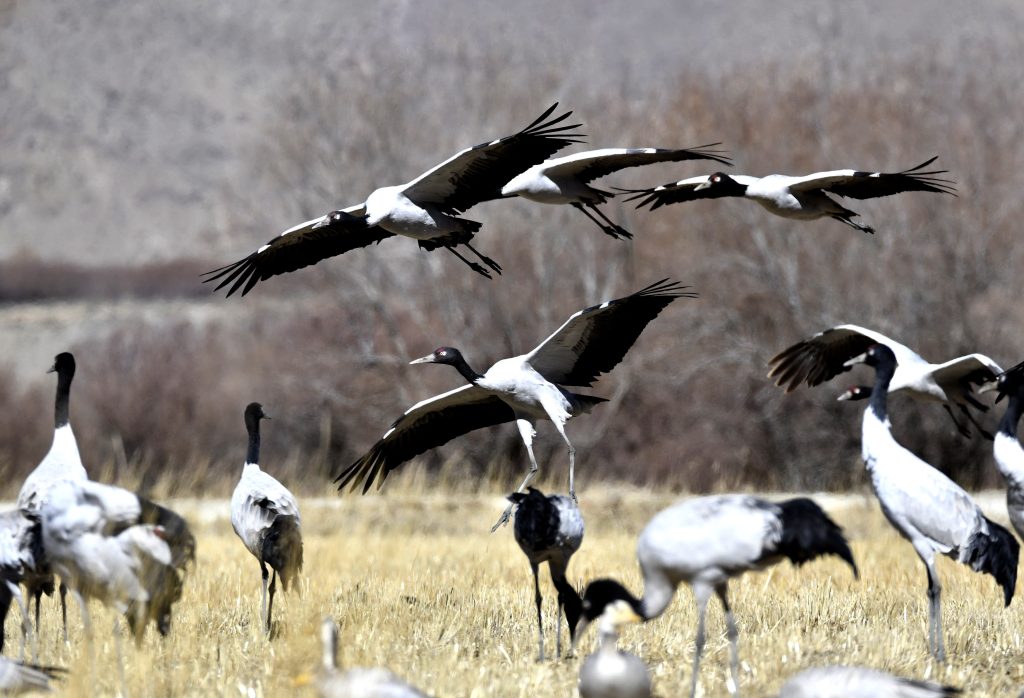
Police in Meigu county in Liangshan, Sichuan, recently received a report from the School of Ecology and Nature Conservation, Beijing Forestry University, which said that a black-necked crane with a tracker for scientific research had remained in a static status for an extended period. The institute asked for an investigation into the condition of the migratory bird.
The police immediately formed a task force to investigate into the incident in the outskirts of a sparsely populated hamlet.
After extensive investigations and visits, the police finally tracked down the suspect surnamed Jike.
Jike confessed under interrogation that he illegally captured and killed the rare species of the endangered wildlife animal black-necked crane.
According to Jike, he happened to see the big bird resting on the river bank on his way home and the idea of catching and eating the bid just occurred to him. A thought that he soon followed up on.
According to the judicial appraisal results by a forestry judicial appraisal center in Sichuan, the bird killed by the suspect was a black-necked crane, which is one of China’s national first-class key protected animals. The tracking device tied to the bird’s foot and the serial number show that the black-necked crane was exactly the one that was used for ecological study of migration of the crane by the college institute.
Jike has been placed under criminal detention by the police for the suspicion of the crime of endangering precious and endangered wildlife animal. The case is currently under further investigation.
According to media reports, the black-necked crane is the only species of crane endemic to China and is among the 15 crane species that currently exist in the world. It is also the only crane species in the world that grows and breeds on plateaus, earning it the titles of “plateau fairy” and “plateau divine bird.”
China’s top legislature passed regulation on February 24, 2020 to strictly ban the illegal wildlife trade and eliminate bad habits of eating wild animals in China to safeguard people’s health and livelihoods.
According to China’s Criminal Law, anyone who illegally captures, kills, transports, purchases or sells national protected, precious, endangered wildlife and their products, shall be sentenced to imprisonment for up to five years or faced with criminal detention, along with a fine.
In cases of serious circumstances, the punishment may be extended to 5-10 years of imprisonment, along with a fine. In particularly severe cases, the sentence may be more than 10 years of imprisonment, along with a fine or confiscation of property and assets.
Preliminary investigation shows the separation of carriages accident along the Changping Line of Beijing subway on Thursday evening was due to the snowy weather, which affected the train's braking system, resulting in a rear-end collision with the front train, Beijing transportation authorities said on Friday.
Around 11:00 pm on Thursday, the personnel transfer was completed, and the on-site disposal work basically finished. A total of 515 people were sent to the hospital for examination, and 102 people were found to have suffered fractures, with no fatalities, the authorities said on Friday.
According to the authorities' announcement, the accident occurred as a result of the slippery tracks caused by the snowy weather. The preceding train had to make an emergency brake to stop. Unfortunately, the following train was situated in a downhill section, making it difficult to effectively brake due to the snowy conditions.
Beijing transportation authority apologized for the inconvenience, fright, and injuries caused to the passengers in this accident, and vowed to do a good job in carrying out post-accident work and conduct a comprehensive investigation to improve extreme weather operation and emergency response to ensure the safety of operations.
It was at 6:57 pm on Thursday, when a rear-end collision occurred in the section between Xi’erqi to Life Science Park stations of the Changping Line. The municipal government officials immediately went to the scene and set up a working group for on-site accident disposal. The relevant departments including transportation, firefighting, health, public security and emergency response responded quickly and made efforts for rescue, according to the authorities.
As of 6 am on Friday, 423 people have been discharged from hospital, 25 people are under observation, and 67 people are receiving hospital treatment, the authorities said.
On Friday, Beijing Subway apologized again over the incident, while putting in place measures to reduce inconvenience for passengers.
Currently, the Beijing municipal government has established an investigation team for the Changping Line accident, which will further investigate the cause of the accident, evaluate the emergency response, and learn lessons from the accident, effectively carrying out rectification measures.
The Chengdu FISU World University Games concluded on Tuesday as the hosts, the Chinese delegation, finished with 103 gold, 40 silver and 35 bronze medals to sit at the top of the medal table, setting a new record for the best results for China at a FISU Games.
The world-leading Chinese university swimming team has been the biggest contributor for China's medal haul at the Games, as the Chinese swimmers totaled 18 gold and two bronze medals.
Besides the big stars such as multiple-time gold medalists Qin Haiyang, Zhang Yufei and Li Bingjie, names such as five-time National Para Games gold medalist Peng Huidi, who faces a lasting hearing issue, also took the stage.
The Central South University student, who had to rely on a visual confirmation at the start of the race, compared to her opponents who dive into the pool after hearing the starting horn, is a slow starter in every race.
However, she had successfully improved her result in the 1,500 meters freestyle by a stunning 32.3 seconds.
Beyond the outstanding performances delivered by the Chinese delegation, which consisted of a total of 411 athletes participating in all 18 events, the tournament has a lot of memorable moments.
Communication, understanding
FISU Acting President Leonz Eder said Tuesday that Chengdu has really made all dreams come true as he reviews the Games.
"What we have witnessed here in Chengdu is state of the art. It's the best we can have. It's really fantastic for the athletes, for the spectators, for everybody," he told reporters. "There's nothing to complain about."
FISU Secretary-General Eric Saintrond believes that hosting the Chengdu Universiade has helped foster China's global image as many young people come to visit the city.
"What you see and hear is different from what people tell you," Saintrond said. "Many people have never been to Chengdu and to China."
As for the impact of the FISU Games on the youth, Acting President Eder affirmed that the Games showcased the importance of communication, understanding, and learning from different cultures.
He asserted that fostering open dialogue and embracing diverse viewpoints is key to creating a better world.
"In some parts of the world, people stopped talking to each other, but the young generation, they don't know these borders, these frontiers," Eder told the Global Times.
"They talk to each other, they learn their own stories, they tell their own stories, they start to communicate, and these are the students, because the students, they speak different languages, and they have no shy to meet other people, and this is really what we believe is needed to make a better world," Eder said of the young people of the world.
"Don't think that your opinion is the only one in the world. We have so many different opinions, different cultures, based on different histories, not one is better than the other, but go and talk to each other, learn from each other, and this is the basic for creating a better world."
Showcasing Chinese culture
The Chengdu FISU Games, the first international multi-sport tournament held in West China, have also become a platform for athletes worldwide to learn about the diverse Chinese culture.
The cultural fair is among the most popular destinations for athletes every night after their competitions.
"One of the pillars of FISU is education, culture, and sport. We do not just organize sport event. For us it is important to show the young people to give the opportunity to discover the culture, the richness of every place where we are going," Eder said.
Saintrond highlighted that after the two postponements of the originally scheduled 2021 event, the Universiade was able to provide more opportunities to students to learn about China.
Saintrond said China hosting an open Universiade, rather than in a closed loop like Tokyo Olympics and Beijing 2022 due to COVID-19, is of much significance.
"It was not only to open the [Games] Village and allow the people to go out of the Village. It is to open the door to the Chinese culture. That has been extremely important for students," he said. "The sports competition is one thing, but the people have to meet each other, have to make friends to get to learn the culture and the history of other nations."
As Chengdu moves forward to host future sports events, such as the 2025 World Games, venues and facilities as well as the volunteers and staff for the FISU Games are likely to be involved again.
"These facilities will be used not only for university students, but also for the citizens of Chengdu and the province," Eder said.
"With these fantastic facilities, you can host future games, whether it's world championships or the World Games .... It's important to use all these venues."